communities
Integrating social learning into a B2B LMS experience, driving +40% sales growth and 2.5× monthly active users.
2025 – 2026
<contribution>
Product design, ux/ui
<impact>
+40% Sales, 2.5× MAU
<tools>
Figma, Claude, Maze, Gemini, Glean
> outcome
Post-launch results reflected a 40% uplift in sales. MAU grew 2.5 times, reflecting consistent user retention over time. The product evolved from a disconnected social add-on into a substantial part of the training experience, making platform more unified, expert-driven, and something customers actually wanted to buy into and renew.
SALES
GROWTH
MONTHLY ACTIVE
USERS INCREASE
"When working on features that required a deeper understanding of user behavior, Daria sought answers in data, going beyond assumptions and qualitative impressions to ground her design decisions in evidence. In my experience, this is rarer than it should be."
Giacomo Clemente
Director of Data Strategy at Docebo
> context & problem
The platform is a leading AI Learning management system serving thousands enterprise organizations to train their employees at scale. Community existed as a standalone product, but lived completely outside the training experience. This project aimed to bring learning and community together by integrating a social layer across the full learning journey.
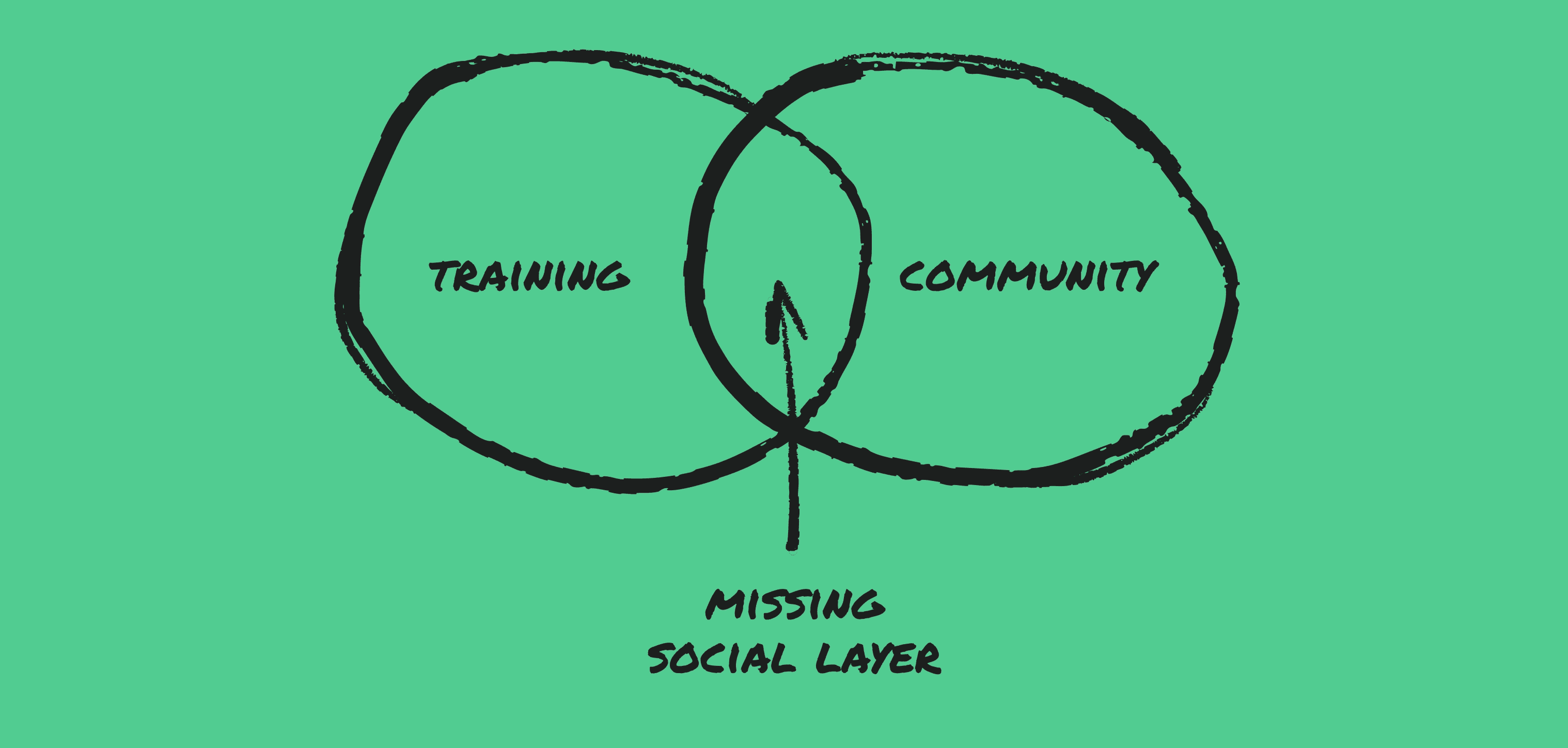
Admins and learners perceived Community product as a “separate destination” from training. They had to leave training context, jump into Community, and then (hopefully) remember to come back. Customers saw Community as "nice to have," not essential – and feedback and renewal rates reflected that.
This led to:
Low discoverability of relevant peer knowledge
Reduced participation in cohort- or program-driven initiatives
Limited visibility of experts and slower response times
Repeated questions
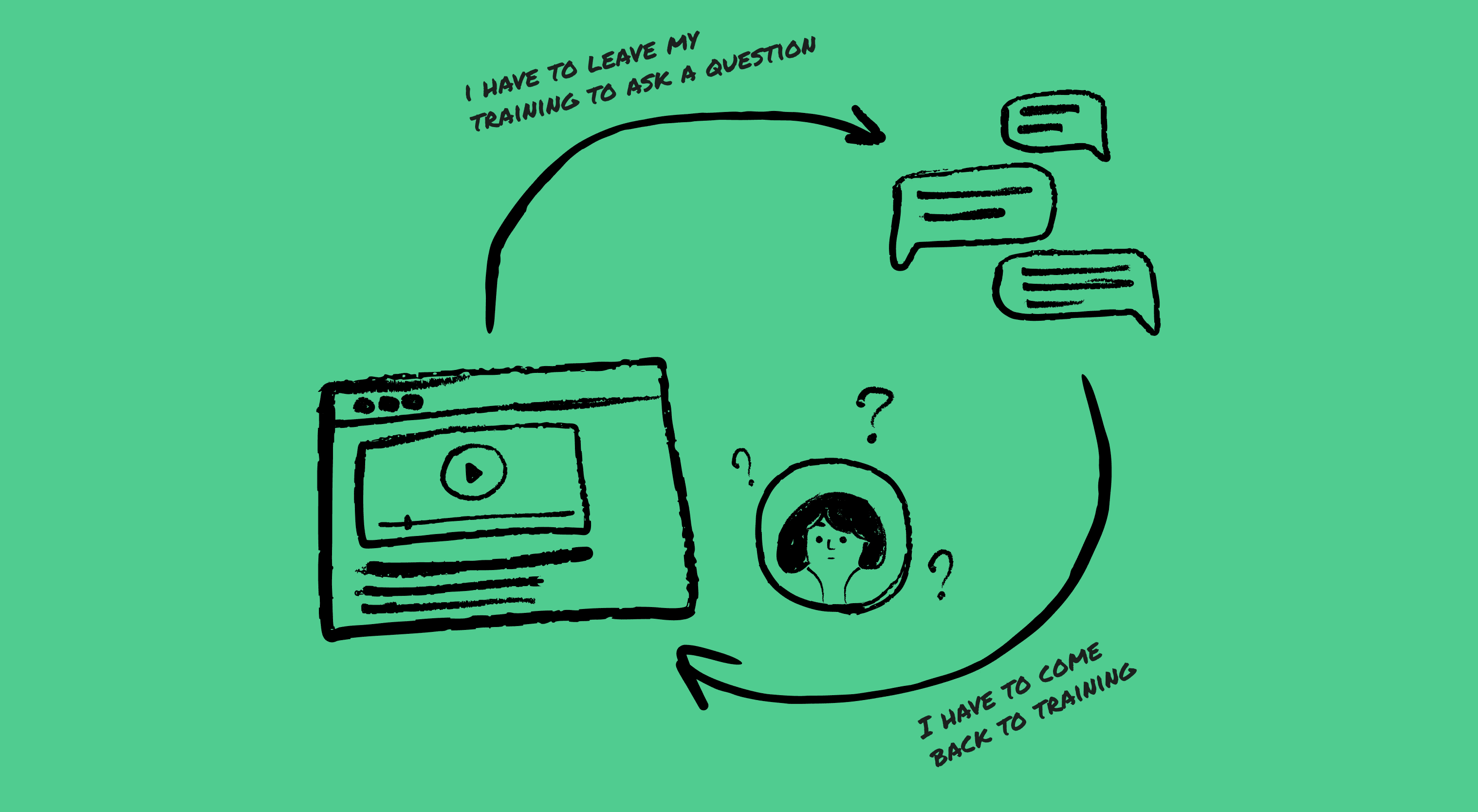
Community felt like a separate destination, not part of the learning journey.
> my role & approach
As the lead product designer for Community product, I owned the end-to-end design from research through delivery. I partnered closely with a PM to define strategy and requirements, collaborated with engineers to navigate technical constraints, and facilitated cross-functional workshops. I conducted user research, defined the UX metrics framework, and led design decisions across all integration features.
> research
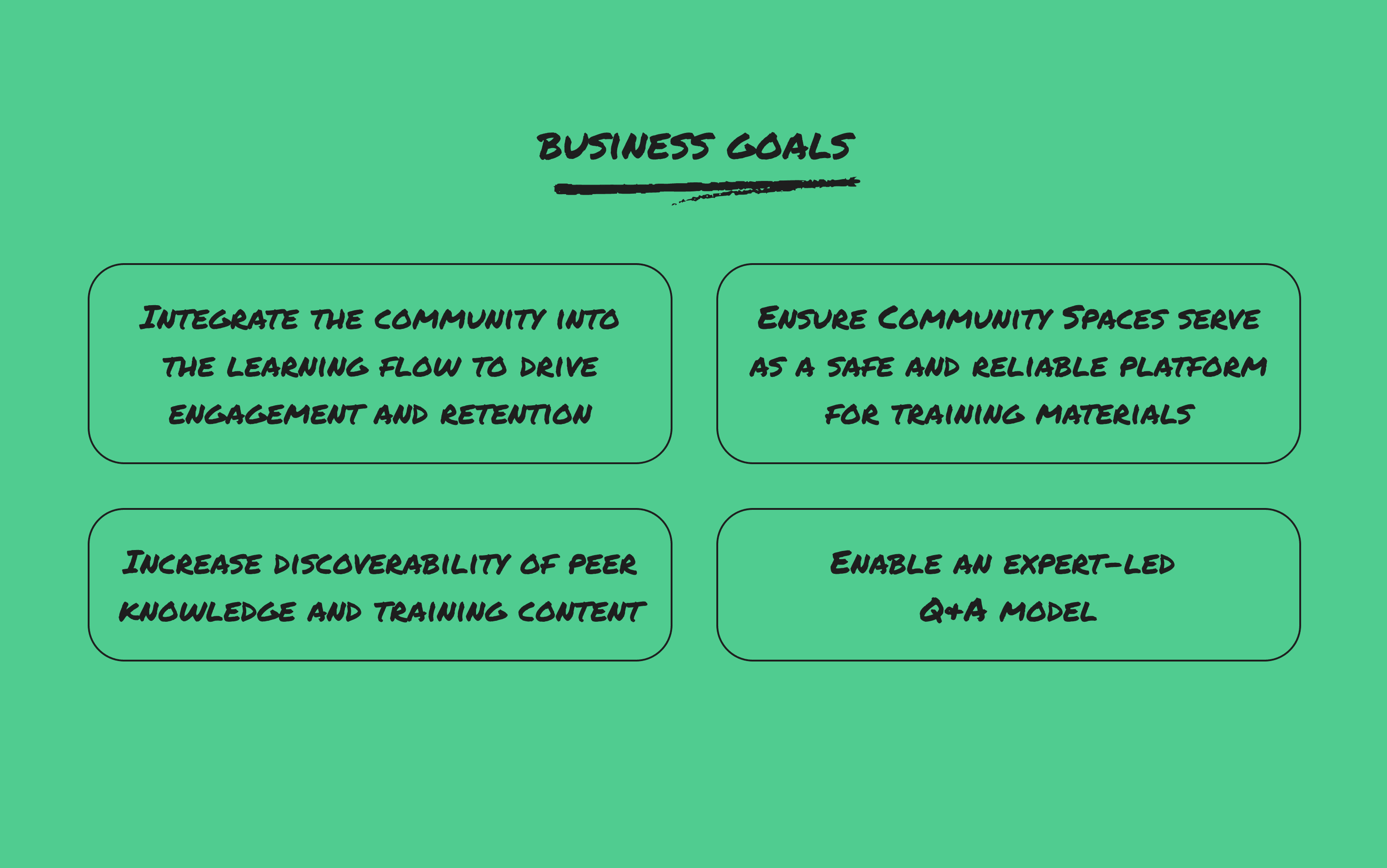
I needed to understand how admins and learners perceived and navigated between community and LMS, and where that experience broke down.
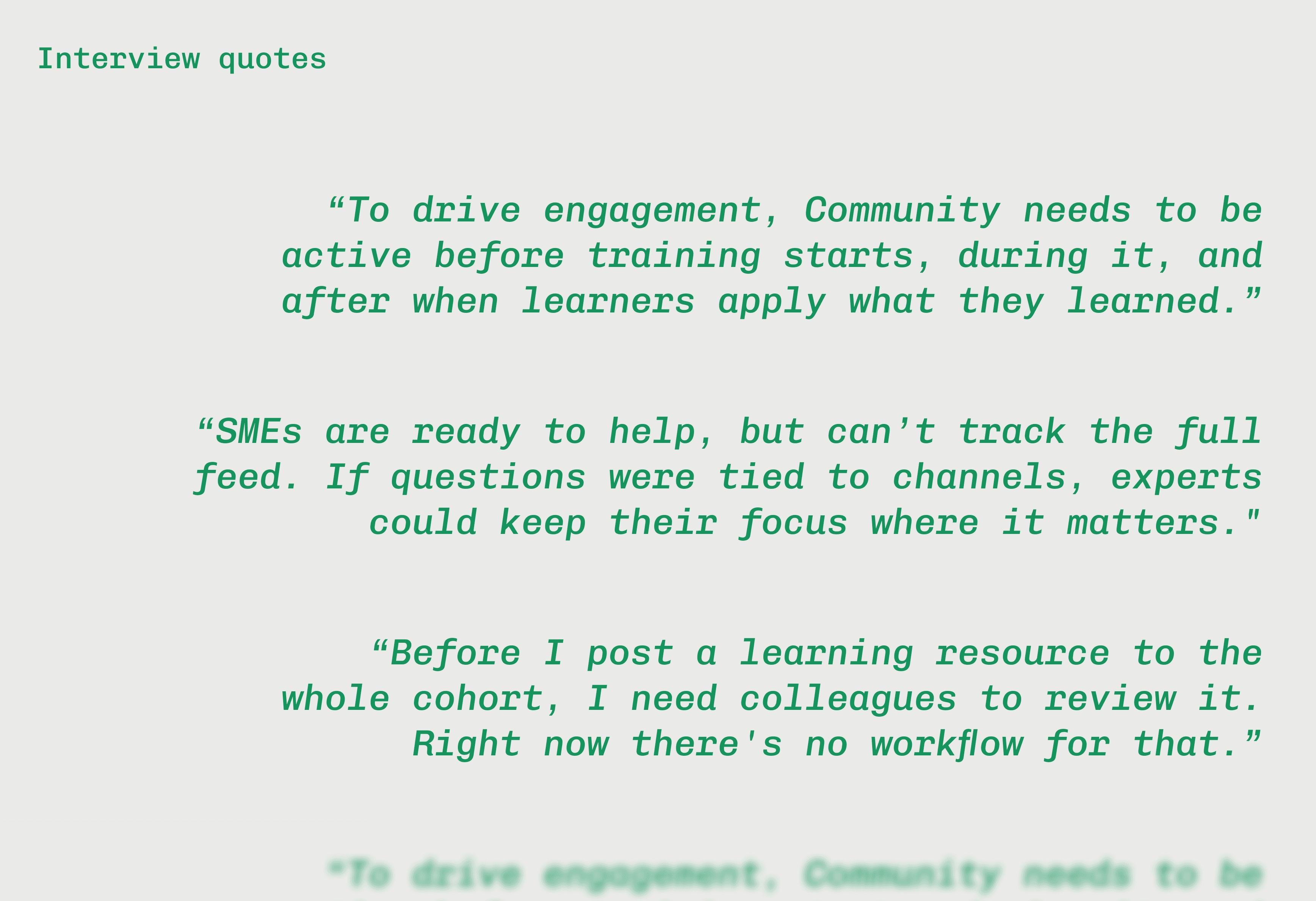
Together with PM and UX Researcher I conducted 10+ customer interviews to gather feedback on current pain points, needs, and feature requests. I analyzed data in the Glean AI platform, which consolidated existing feedback and requests from internal company sources. Additionally, I ran a competitive analysis and mapped learner and admin journeys.
Based on the research findings, I formulated the main hypotheses:
If Community conversations are embedded directly into the learning experience, then learner participation rate (posts/comments per active learner per session) will increase.
If conversations are contextualized around specific training content, then user engagement and % of solved questions will increase.
If admins have more control over visibility and content configuration, then configured community spaces will show higher engagement.
Together with PM and UX Researcher I conducted 10+ customer interviews to gather feedback on current pain points, needs, and feature requests. I analyzed data in the Glean AI platform, which consolidated existing feedback and requests from internal company sources. I also ran a competitive analysis and ran a JTBD exercise for Admin and Learner personas.
> insights
Context-switching killed participation.
Reaching Community took multiple steps and forced users to abandon their learning flow.
Training resources were fragmented across systems.
Materials and the conversations about them lived in separate systems.
Content felt noisy and uncurated
…increasing moderation effort and reducing perceived quality.
Questions lacked clear ownership
…leading to unanswered threads and missed learning opportunities.
The research revealed that the biggest challenge was not a lack of community features, but the fragmentation between learning and social experiences. Admins and learners perceived them as separate products, which created context switching and reduced engagement.
This reframed the goal: "dissolve the boundary between learning and conversations".
The main issue wasn't just low discoverability – it was fragmentation.
> ux metrics
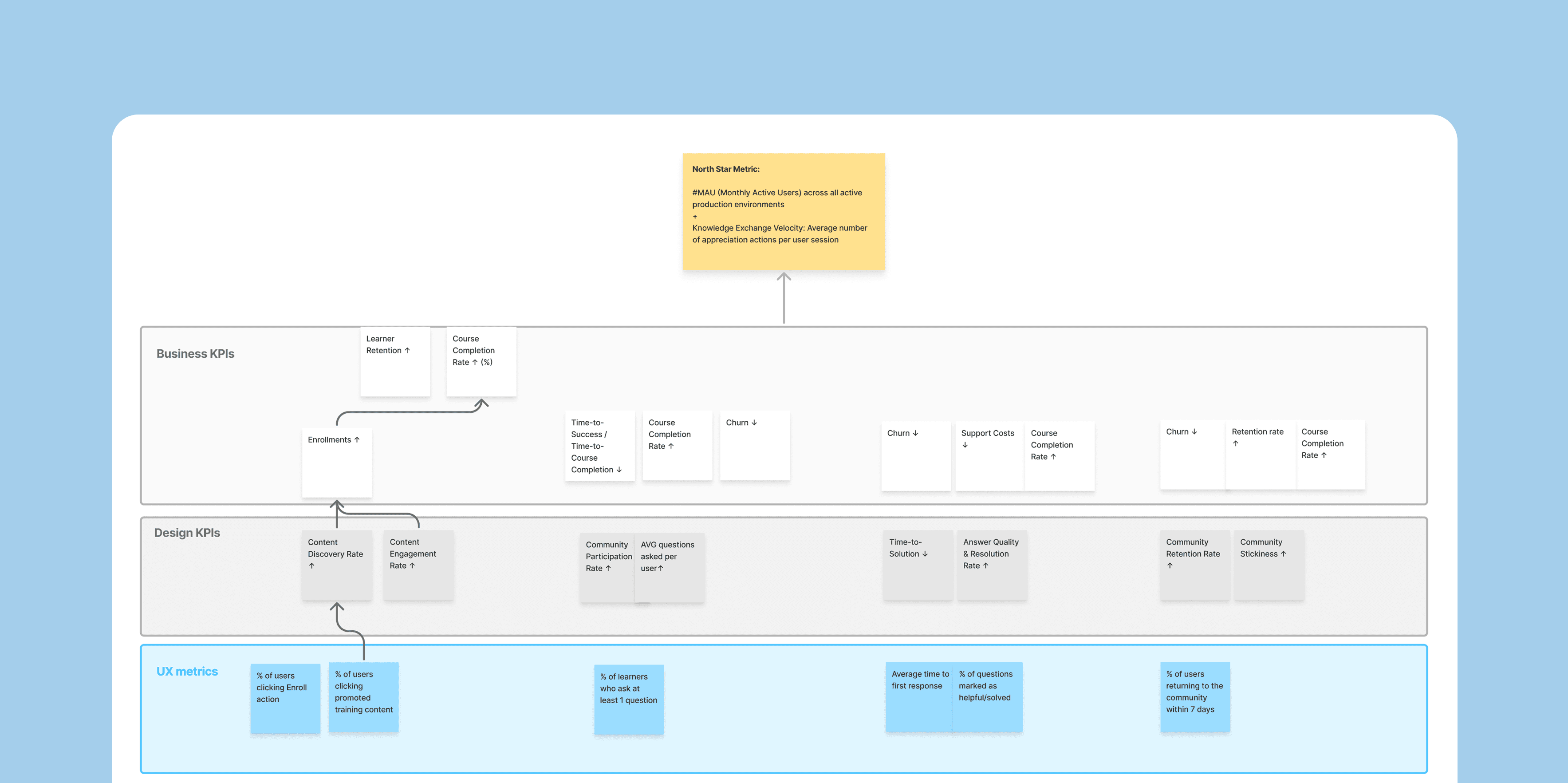
Before jumping into solutions, I wanted to understand how design would drive business impact. That meant aligning the team on what success actually looked like before any design decisions were made. I facilitated a workshop with the PM, Design Manager, and UX Researcher to define clear UX metrics. As a first step, I used Event Storming framework to map the user journey and identify critical "success moments" and friction points that could potentially block them.
We created a KPI tree that broke down a high-level business goal (the North Star metric) into clear, measurable business and design KPIs, and further into actionable UX metrics. Each UX metric was tied to a known user need or pain point, along with potential design solutions. I found this framework to be an effective tool to communicate with stakeholders and focus on design decisions that truly drive business impact.
> challenges
The business push was to move fast and ship new features using existing (old) components. We were building new features while the company transitioned to an updated design system. Every component came in two versions: old and new – and mixing them looked exactly as bad as it sounds.
Without a clear approach, the product risked turning into a fragmented, “Frankenstein” experience. To tackle this problem, I initiated a series of workshops with engineers and the PM to align on a shared strategy. Together, we defined a clear set of priorities and a shared plan for building new features within the updated system, balancing speed with long-term scalability. This gave the team a consistent decision-making framework instead of ad hoc choices under pressure.
Given timeline constraints and ownership boundaries, we also made a trade-off: some admin settings remained in a legacy panel we couldn’t fully rebuild. Integrating new settings into it introduced technical complexity which meant making some careful (and sometimes painful) design compromises to keep things consistent. We focused on prioritizing learner experience and minimizing friction: aligning visual consistency where possible, reducing visual noise, and creating clearer boundaries between legacy and new experiences.
This approach allowed us to ship on time while minimizing technical debt and avoiding a broken user experience, and it created a clear path for future migration rather than compounding inconsistency.

> validation & iteration
I used Figma Make and AI tools to iterate quickly and prepare concepts to test and review during stakeholder and clients meetings.
Together with my team, I tested and validated our design proposals with key clients, receiving positive feedback and valuable insights that enabled us to further refine and polish our solutions, confirming we were addressing their needs. I also tested prototypes through unmoderated usability testing in Maze. Early testing revealed a few gaps – the need for more flexible admin controls to manage hidden spaces. Admins wanted to create private conversations within training contexts without cluttering the main community feed.
Once the proposal was refined and validated, I moved on to creating high-fidelity mockups, translating our concepts into detailed, production-ready designs.
> design decisions
Conversations, inside the learning flow
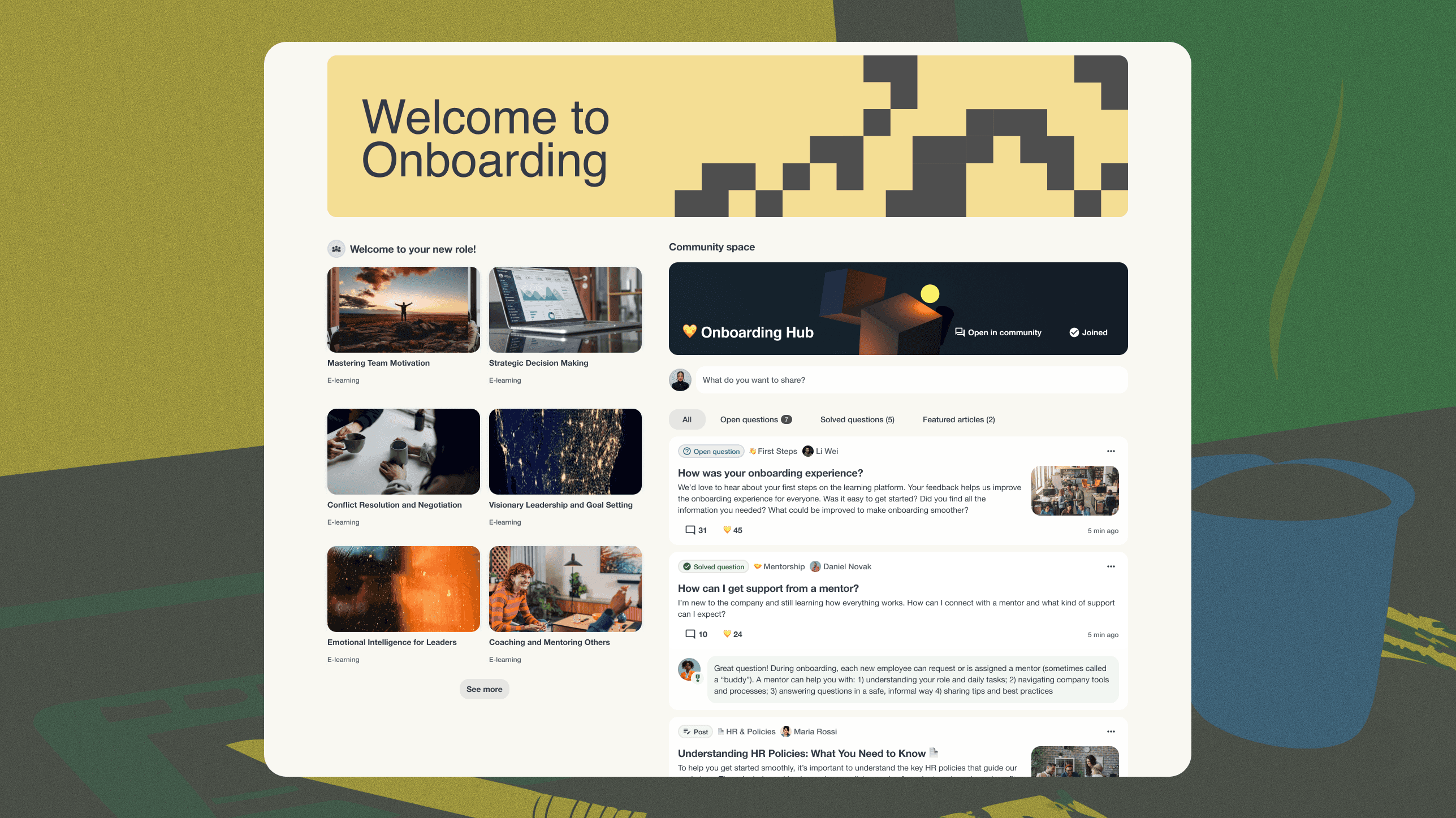
Learners needed to see relevant conversations without leaving their training workflow.
I designed the widget to display only the Community Space linked to the current LMS page/course, configurable by admins in settings. This aligned with how learners actually used Community – seeking help right when they got stuck.
Content heroes
Admins needed to highlight content in space feeds to promote key learning materials.
I designed a promoted content system that surfaces training content as visual “hero” units at the top of the feed, with the option to collapse them when not needed.

File attachments
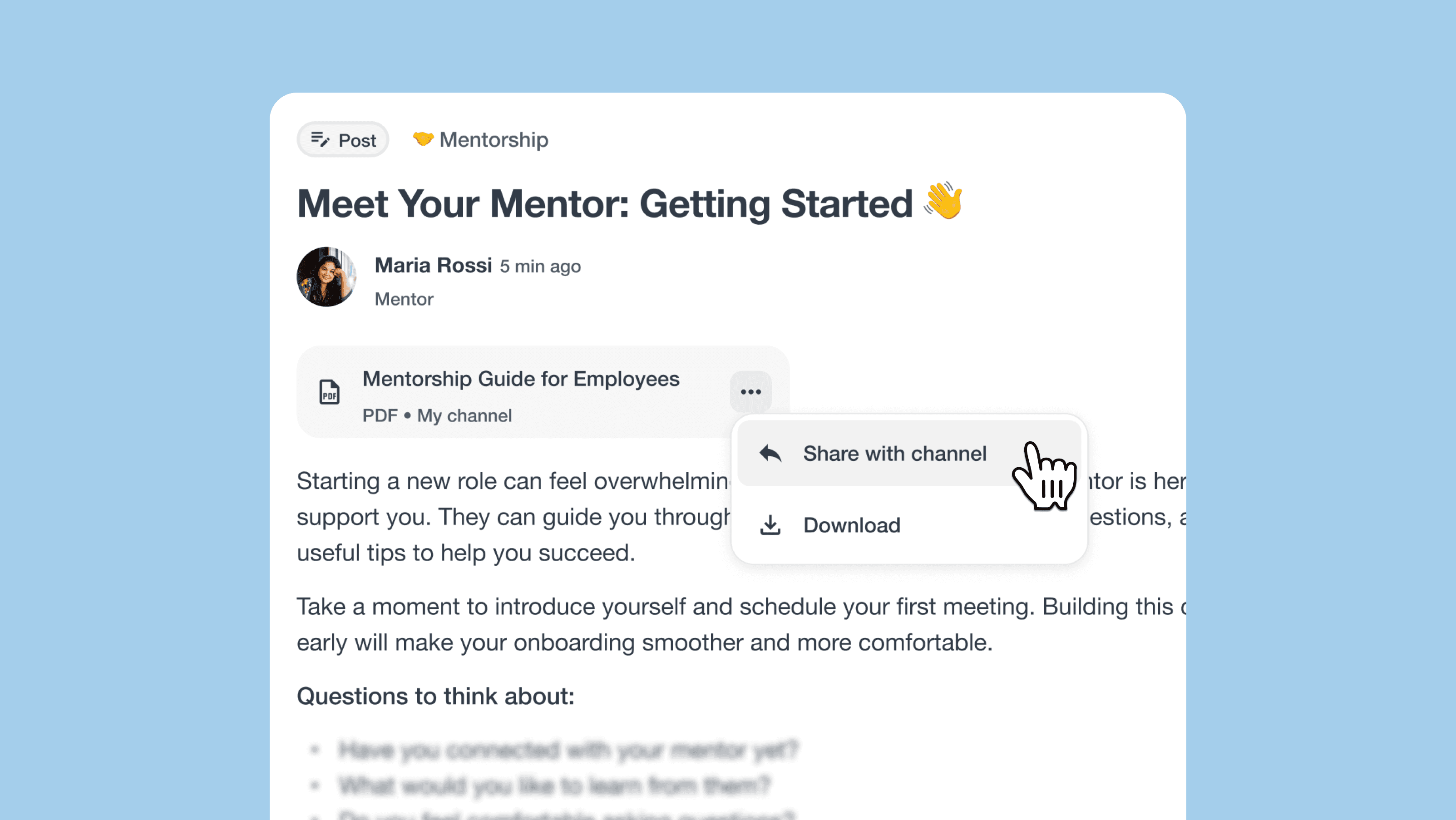
Sharing training files was cumbersome – users relied on external tools or uploaded files separately.
I extended the post composer to support file attachments, allowing users to upload files directly to their personal library or public LMS channels, making sharing and collaboration more seamless.
Hidden spaces
Admins wanted Spaces to be "prominent within LMS pages and courses but invisible outside it"
I designed "hidden spaces" – spaces that don't appear on the Community homepage but are fully embedded and discoverable within LMS pages. This solved the admin need for "private conversations" without building a complex permissions system. I validated this with low-fidelity prototypes and tested it with key clients. Their feedback: "This is exactly what we needed for cohort-based programs and sensitive training topics"
Configurable community spaces
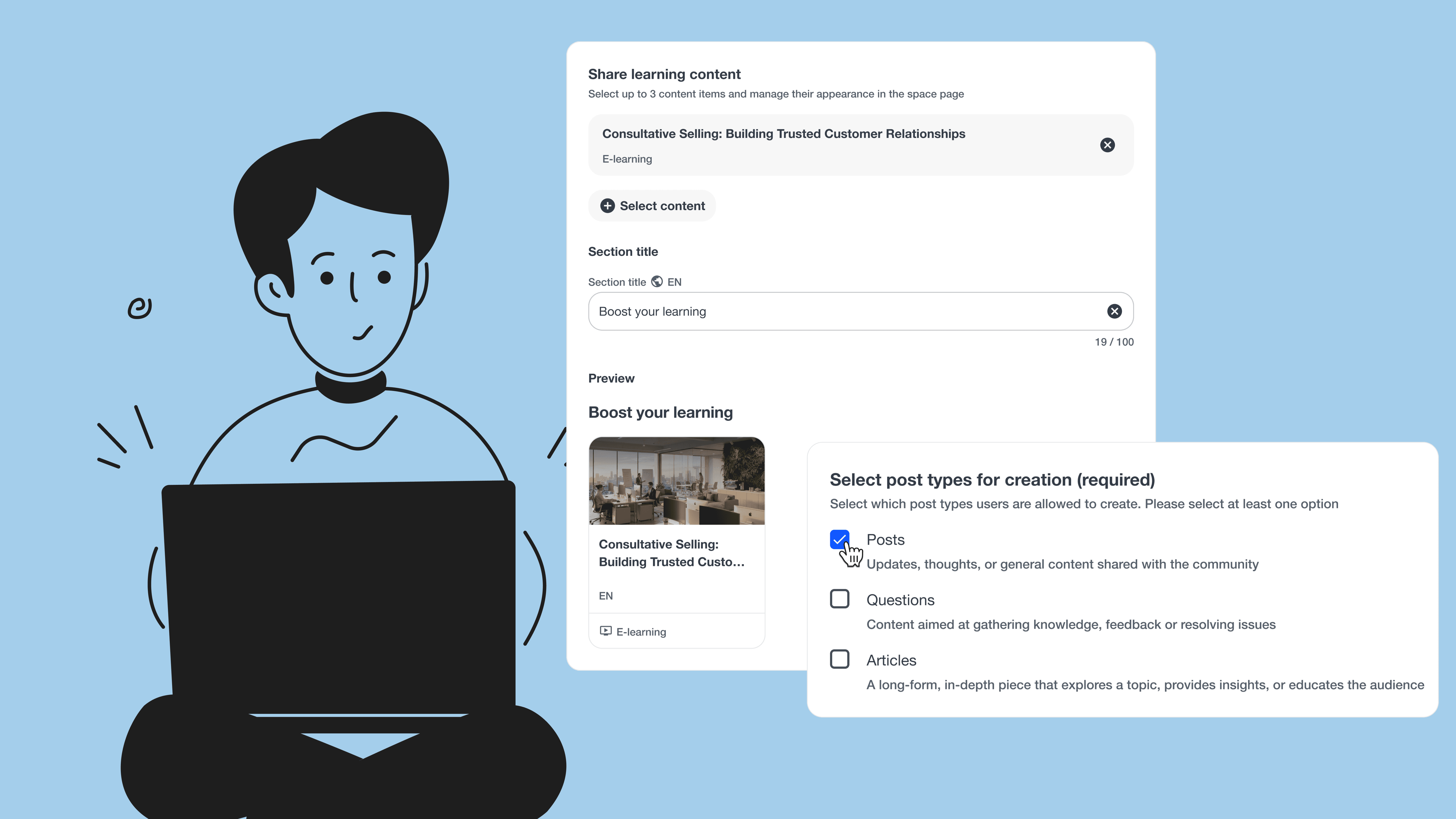
Admins needed more content control – defining content types, managing permissions, curating participation.
I introduced flexible Space configuration options that let admins define: content types allowed, visibility rules, publishing controls.
> learnings
This project strengthened my ability to lead design decisions, own cross-functional activities, and navigate technical trade-offs with engineering. Continuous validation with key clients taught me to distinguish actionable feedback from noise and defend strategic choices while constraints required tough prioritization.
What I'd do differently:
Earlier involvement of engineering in the design decisions. I’d involve engineering earlier and define the design system strategy at kickoff, not mid-project. Early alignment would have given the team a clearer, more consistent direction.
Involve learners (not just admins) more in validation. Most validation focused on admin experience. I’d prioritize testing with learners when possible, since their feedback would have provided valuable insights and increased confidence in the solution before launch.
Document the rationale behind key decisions. I'd document design rationale more consistently throughout the process. There were moments in stakeholder discussions where I had to reconstruct my thinking on the spot. Having a clear record of why each decision was made would have made those conversations more confident and easier to revisit during iterations.
▼ other cases

Built with ❤︎ in Framer + Claude
22:17:52
9/9/2026
communities
Integrating social learning into a B2B LMS experience, driving +40% sales growth and 2.5× monthly active users.
2025 – 2026
<contribution>
Product design, ux/ui
<impact>
+40% Sales, 2.5× MAU
<tools>
Figma, Claude, Maze, Gemini, Glean
> outcome
Post-launch results reflected a 40% uplift in sales. MAU grew 2.5 times, reflecting consistent user retention over time. The product evolved from a disconnected social add-on into a substantial part of the training experience, making platform more unified, expert-driven, and something customers actually wanted to buy into and renew.
SALES
GROWTH
MONTHLY ACTIVE
USERS INCREASE
"When working on features that required a deeper understanding of user behavior, Daria sought answers in data, going beyond assumptions and qualitative impressions to ground her design decisions in evidence. In my experience, this is rarer than it should be."
Giacomo Clemente
Director of Data Strategy at Docebo
> context & problem
The platform is a leading AI Learning management system serving thousands enterprise organizations to train their employees at scale. Community existed as a standalone product, but lived completely outside the training experience. This project aimed to bring learning and community together by integrating a social layer across the full learning journey.
Admins and learners perceived Community product as a “separate destination” from training. They had to leave training context, jump into Community, and then (hopefully) remember to come back. Customers saw Community as "nice to have," not essential – and feedback and renewal rates reflected that.
This led to:
Low discoverability of relevant peer knowledge
Reduced participation in cohort- or program-driven initiatives
Limited visibility of experts and slower response times
Repeated questions
Community felt like a separate destination, not part of the learning journey.
> my role & approach
As the lead product designer for Community product, I owned the end-to-end design from research through delivery. I partnered closely with a PM to define strategy and requirements, collaborated with engineers to navigate technical constraints, and facilitated cross-functional workshops. I conducted user research, defined the UX metrics framework, and led design decisions across all integration features.
> research
I needed to understand how admins and learners perceived and navigated between community and LMS, and where that experience broke down.
Together with PM and UX Researcher I conducted 10+ customer interviews to gather feedback on current pain points, needs, and feature requests. I analyzed data in the Glean AI platform, which consolidated existing feedback and requests from internal company sources. Additionally, I ran a competitive analysis and mapped learner and admin journeys.
Based on the research findings, I formulated the main hypotheses:
If Community conversations are embedded directly into the learning experience, then learner participation rate (posts/comments per active learner per session) will increase.
If conversations are contextualized around specific training content, then user engagement and % of solved questions will increase.
If admins have more control over visibility and content configuration, then configured community spaces will show higher engagement.
Together with PM and UX Researcher I conducted 10+ customer interviews to gather feedback on current pain points, needs, and feature requests. I analyzed data in the Glean AI platform, which consolidated existing feedback and requests from internal company sources. I also ran a competitive analysis and ran a JTBD exercise for Admin and Learner personas.
> insights
Context-switching killed participation.
Reaching Community took multiple steps and forced users to abandon their learning flow.
Training resources were fragmented across systems.
Materials and the conversations about them lived in separate systems.
Content felt noisy and uncurated
…increasing moderation effort and reducing perceived quality.
Questions lacked clear ownership
…leading to unanswered threads and missed learning opportunities.
The research revealed that the biggest challenge was not a lack of community features, but the fragmentation between learning and social experiences. Admins and learners perceived them as separate products, which created context switching and reduced engagement.
This reframed the goal: "dissolve the boundary between learning and conversations".
The main issue wasn't just low discoverability – it was fragmentation.
> ux metrics
Before jumping into solutions, I wanted to understand how design would drive business impact. That meant aligning the team on what success actually looked like before any design decisions were made. I facilitated a workshop with the PM, Design Manager, and UX Researcher to define clear UX metrics. As a first step, I used Event Storming framework to map the user journey and identify critical "success moments" and friction points that could potentially block them.
We created a KPI tree that broke down a high-level business goal (the North Star metric) into clear, measurable business and design KPIs, and further into actionable UX metrics. Each UX metric was tied to a known user need or pain point, along with potential design solutions. I found this framework to be an effective tool to communicate with stakeholders and focus on design decisions that truly drive business impact.
> challenges
The business push was to move fast and ship new features using existing (old) components. We were building new features while the company transitioned to an updated design system. Every component came in two versions: old and new – and mixing them looked exactly as bad as it sounds.
Without a clear approach, the product risked turning into a fragmented, “Frankenstein” experience. To tackle this problem, I initiated a series of workshops with engineers and the PM to align on a shared strategy. Together, we defined a clear set of priorities and a shared plan for building new features within the updated system, balancing speed with long-term scalability. This gave the team a consistent decision-making framework instead of ad hoc choices under pressure.
Given timeline constraints and ownership boundaries, we also made a trade-off: some admin settings remained in a legacy panel we couldn’t fully rebuild. Integrating new settings into it introduced technical complexity which meant making some careful (and sometimes painful) design compromises to keep things consistent. We focused on prioritizing learner experience and minimizing friction: aligning visual consistency where possible, reducing visual noise, and creating clearer boundaries between legacy and new experiences.
This approach allowed us to ship on time while minimizing technical debt and avoiding a broken user experience, and it created a clear path for future migration rather than compounding inconsistency.
> validation & iteration
I used Figma Make and AI tools to iterate quickly and prepare concepts to test and review during stakeholder and clients meetings.
Together with my team, I tested and validated our design proposals with key clients, receiving positive feedback and valuable insights that enabled us to further refine and polish our solutions, confirming we were addressing their needs. I also tested prototypes through unmoderated usability testing in Maze. Early testing revealed a few gaps – the need for more flexible admin controls to manage hidden spaces. Admins wanted to create private conversations within training contexts without cluttering the main community feed.
Once the proposal was refined and validated, I moved on to creating high-fidelity mockups, translating our concepts into detailed, production-ready designs.
> design decisions
Conversations, inside the learning flow
Learners needed to see relevant conversations without leaving their training workflow.
I designed the widget to display only the Community Space linked to the current LMS page/course, configurable by admins in settings. This aligned with how learners actually used Community – seeking help right when they got stuck.
Content heroes
Admins needed to highlight content in space feeds to promote key learning materials.
I designed a promoted content system that surfaces training content as visual “hero” units at the top of the feed, with the option to collapse them when not needed.
File attachments
Sharing training files was cumbersome – users relied on external tools or uploaded files separately.
I extended the post composer to support file attachments, allowing users to upload files directly to their personal library or public LMS channels, making sharing and collaboration more seamless.
Hidden spaces
Admins wanted Spaces to be "prominent within LMS pages and courses but invisible outside it"
I designed "hidden spaces" – spaces that don't appear on the Community homepage but are fully embedded and discoverable within LMS pages. This solved the admin need for "private conversations" without building a complex permissions system. I validated this with low-fidelity prototypes and tested it with key clients. Their feedback: "This is exactly what we needed for cohort-based programs and sensitive training topics"
Configurable community spaces
Admins needed more content control – defining content types, managing permissions, curating participation.
I introduced flexible Space configuration options that let admins define: content types allowed, visibility rules, publishing controls.
> learnings
This project strengthened my ability to lead design decisions, own cross-functional activities, and navigate technical trade-offs with engineering. Continuous validation with key clients taught me to distinguish actionable feedback from noise and defend strategic choices while constraints required tough prioritization.
What I'd do differently:
Earlier involvement of engineering in the design decisions. I’d involve engineering earlier and define the design system strategy at kickoff, not mid-project. Early alignment would have given the team a clearer, more consistent direction.
Involve learners (not just admins) more in validation. Most validation focused on admin experience. I’d prioritize testing with learners when possible, since their feedback would have provided valuable insights and increased confidence in the solution before launch.
Document the rationale behind key decisions. I'd document design rationale more consistently throughout the process. There were moments in stakeholder discussions where I had to reconstruct my thinking on the spot. Having a clear record of why each decision was made would have made those conversations more confident and easier to revisit during iterations.
▼ other cases
Built with ❤︎ in Framer + Claude
22:17:52
9/9/2026
communities
Integrating social learning into a B2B LMS experience, driving +40% sales growth and 2.5× monthly active users.
2025 – 2026
<contribution>
Product design, ux/ui
<impact>
+40% Sales, 2.5× MAU
<tools>
Figma, Claude, Maze, Gemini, Glean
> outcome
Post-launch results reflected a 40% uplift in sales. MAU grew 2.5 times, reflecting consistent user retention over time. The product evolved from a disconnected social add-on into a substantial part of the training experience, making platform more unified, expert-driven, and something customers actually wanted to buy into and renew.
SALES
GROWTH
MONTHLY ACTIVE
USERS INCREASE
"When working on features that required a deeper understanding of user behavior, Daria sought answers in data, going beyond assumptions and qualitative impressions to ground her design decisions in evidence. In my experience, this is rarer than it should be."
Giacomo Clemente
Director of Data Strategy at Docebo
> context & problem
The platform is a leading AI Learning management system serving thousands enterprise organizations to train their employees at scale. Community existed as a standalone product, but lived completely outside the training experience. This project aimed to bring learning and community together by integrating a social layer across the full learning journey.
Admins and learners perceived Community product as a “separate destination” from training. They had to leave training context, jump into Community, and then (hopefully) remember to come back. Customers saw Community as "nice to have," not essential – and feedback and renewal rates reflected that.
This led to:
Low discoverability of relevant peer knowledge
Reduced participation in cohort- or program-driven initiatives
Limited visibility of experts and slower response times
Repeated questions
Community felt like a separate destination, not part of the learning journey.
> my role & approach
As the lead product designer for Community product, I owned the end-to-end design from research through delivery. I partnered closely with a PM to define strategy and requirements, collaborated with engineers to navigate technical constraints, and facilitated cross-functional workshops. I conducted user research, defined the UX metrics framework, and led design decisions across all integration features.
> research
I needed to understand how admins and learners perceived and navigated between community and LMS, and where that experience broke down.
Together with PM and UX Researcher I conducted 10+ customer interviews to gather feedback on current pain points, needs, and feature requests. I analyzed data in the Glean AI platform, which consolidated existing feedback and requests from internal company sources. Additionally, I ran a competitive analysis and mapped learner and admin journeys.
Based on the research findings, I formulated the main hypotheses:
If Community conversations are embedded directly into the learning experience, then learner participation rate (posts/comments per active learner per session) will increase.
If conversations are contextualized around specific training content, then user engagement and % of solved questions will increase.
If admins have more control over visibility and content configuration, then configured community spaces will show higher engagement.
Together with PM and UX Researcher I conducted 10+ customer interviews to gather feedback on current pain points, needs, and feature requests. I analyzed data in the Glean AI platform, which consolidated existing feedback and requests from internal company sources. I also ran a competitive analysis and ran a JTBD exercise for Admin and Learner personas.
> insights
Context-switching killed participation.
Reaching Community took multiple steps and forced users to abandon their learning flow.
Training resources were fragmented across systems.
Materials and the conversations about them lived in separate systems.
Content felt noisy and uncurated
…increasing moderation effort and reducing perceived quality.
Questions lacked clear ownership
…leading to unanswered threads and missed learning opportunities.
The research revealed that the biggest challenge was not a lack of community features, but the fragmentation between learning and social experiences. Admins and learners perceived them as separate products, which created context switching and reduced engagement.
This reframed the goal: "dissolve the boundary between learning and conversations".
The main issue wasn't just low discoverability – it was fragmentation.
> ux metrics
Before jumping into solutions, I wanted to understand how design would drive business impact. That meant aligning the team on what success actually looked like before any design decisions were made. I facilitated a workshop with the PM, Design Manager, and UX Researcher to define clear UX metrics. As a first step, I used Event Storming framework to map the user journey and identify critical "success moments" and friction points that could potentially block them.
We created a KPI tree that broke down a high-level business goal (the North Star metric) into clear, measurable business and design KPIs, and further into actionable UX metrics. Each UX metric was tied to a known user need or pain point, along with potential design solutions. I found this framework to be an effective tool to communicate with stakeholders and focus on design decisions that truly drive business impact.
> challenges
The business push was to move fast and ship new features using existing (old) components. We were building new features while the company transitioned to an updated design system. Every component came in two versions: old and new – and mixing them looked exactly as bad as it sounds.
Without a clear approach, the product risked turning into a fragmented, “Frankenstein” experience. To tackle this problem, I initiated a series of workshops with engineers and the PM to align on a shared strategy. Together, we defined a clear set of priorities and a shared plan for building new features within the updated system, balancing speed with long-term scalability. This gave the team a consistent decision-making framework instead of ad hoc choices under pressure.
Given timeline constraints and ownership boundaries, we also made a trade-off: some admin settings remained in a legacy panel we couldn’t fully rebuild. Integrating new settings into it introduced technical complexity which meant making some careful (and sometimes painful) design compromises to keep things consistent. We focused on prioritizing learner experience and minimizing friction: aligning visual consistency where possible, reducing visual noise, and creating clearer boundaries between legacy and new experiences.
This approach allowed us to ship on time while minimizing technical debt and avoiding a broken user experience, and it created a clear path for future migration rather than compounding inconsistency.
> validation & iteration
I used Figma Make and AI tools to iterate quickly and prepare concepts to test and review during stakeholder and clients meetings.
Together with my team, I tested and validated our design proposals with key clients, receiving positive feedback and valuable insights that enabled us to further refine and polish our solutions, confirming we were addressing their needs. I also tested prototypes through unmoderated usability testing in Maze. Early testing revealed a few gaps – the need for more flexible admin controls to manage hidden spaces. Admins wanted to create private conversations within training contexts without cluttering the main community feed.
Once the proposal was refined and validated, I moved on to creating high-fidelity mockups, translating our concepts into detailed, production-ready designs.
> design decisions
Conversations, inside the learning flow
Learners needed to see relevant conversations without leaving their training workflow.
I designed the widget to display only the Community Space linked to the current LMS page/course, configurable by admins in settings. This aligned with how learners actually used Community – seeking help right when they got stuck.
Content heroes
Admins needed to highlight content in space feeds to promote key learning materials.
I designed a promoted content system that surfaces training content as visual “hero” units at the top of the feed, with the option to collapse them when not needed.
File attachments
Sharing training files was cumbersome – users relied on external tools or uploaded files separately.
I extended the post composer to support file attachments, allowing users to upload files directly to their personal library or public LMS channels, making sharing and collaboration more seamless.
Hidden spaces
Admins wanted Spaces to be "prominent within LMS pages and courses but invisible outside it"
I designed "hidden spaces" – spaces that don't appear on the Community homepage but are fully embedded and discoverable within LMS pages. This solved the admin need for "private conversations" without building a complex permissions system. I validated this with low-fidelity prototypes and tested it with key clients. Their feedback: "This is exactly what we needed for cohort-based programs and sensitive training topics"
Configurable community spaces
Admins needed more content control – defining content types, managing permissions, curating participation.
I introduced flexible Space configuration options that let admins define: content types allowed, visibility rules, publishing controls.
> learnings
This project strengthened my ability to lead design decisions, own cross-functional activities, and navigate technical trade-offs with engineering. Continuous validation with key clients taught me to distinguish actionable feedback from noise and defend strategic choices while constraints required tough prioritization.
What I'd do differently:
Earlier involvement of engineering in the design decisions. I’d involve engineering earlier and define the design system strategy at kickoff, not mid-project. Early alignment would have given the team a clearer, more consistent direction.
Involve learners (not just admins) more in validation. Most validation focused on admin experience. I’d prioritize testing with learners when possible, since their feedback would have provided valuable insights and increased confidence in the solution before launch.
Document the rationale behind key decisions. I'd document design rationale more consistently throughout the process. There were moments in stakeholder discussions where I had to reconstruct my thinking on the spot. Having a clear record of why each decision was made would have made those conversations more confident and easier to revisit during iterations.
▼ other cases
Built with ❤︎ in Framer + Claude
22:17:52
9/9/2026
communities
Integrating social learning into a B2B LMS experience, driving +40% sales growth and 2.5× monthly active users.
2025 – 2026
<contribution>
Product design, ux/ui
<impact>
+40% Sales, 2.5× MAU
<tools>
Figma, Claude, Maze, Gemini, Glean
> IMPACT
Post-launch results reflected a 40% uplift in sales. MAU grew 2.5 times, reflecting consistent user retention over time. The product evolved from a disconnected social add-on into a substantial part of the training experience, making platform more unified, expert-driven, and something customers actually wanted to buy into and renew.
SALES
GROWTH
MONTHLY ACTIVE
USERS INCREASE
"When working on features that required a deeper understanding of user behavior, Daria sought answers in data, going beyond assumptions and qualitative impressions to ground her design decisions in evidence. In my experience, this is rarer than it should be."
Giacomo Clemente
Director of Data Strategy at Docebo
> context & problem
The platform is a leading AI Learning management system serving thousands enterprise organizations to train their employees at scale. Community existed as a standalone product, but lived completely outside the training experience. This project aimed to bring learning and community together by integrating a social layer across the full learning journey.
Admins and learners perceived Community product as a “separate destination” from training. They had to leave training context, jump into Community, and then (hopefully) remember to come back. Customers saw Community as "nice to have," not essential – and feedback and renewal rates reflected that.
This led to:
Low discoverability of relevant peer knowledge
Reduced participation in cohort- or program-driven initiatives
Limited visibility of experts and slower response times
Repeated questions
Community felt like a separate destination, not part of the learning journey.
> my role & approach
As the lead product designer for Community product, I owned the end-to-end design from research through delivery. I partnered closely with a PM to define strategy and requirements, collaborated with engineers to navigate technical constraints, and facilitated cross-functional workshops. I conducted user research, defined the UX metrics framework, and led design decisions across all integration features.
> research
Because the real issue wasn’t missing features but low discoverability and fragmented experience, I needed to understand how admins and learners perceived and navigated between community and LMS, and where that experience broke down.
Because the real issue wasn’t missing features but low discoverability and fragmented experience, I needed to understand how admins and learners perceived and navigated between community and LMS, and where that experience broke down.
Because the real issue wasn’t missing features but low discoverability and fragmented experience, I needed to understand how admins and learners perceived and navigated between community and LMS, and where that experience broke down.
Together with PM and UX Researcher I conducted 10+ customer interviews to gather feedback on current pain points, needs, and feature requests. I analyzed data in the Glean AI platform, which consolidated existing feedback and requests from internal company sources. I also ran a competitive analysis and ran a JTBD exercise for Admin and Learner personas.
> insights
Context-switching killed participation.
Reaching Community took multiple steps and forced users to abandon their learning flow.
Training resources were fragmented across systems.
Materials and the conversations about them lived in separate systems.
Content felt noisy and uncurated
…increasing moderation effort and reducing perceived quality.
Questions lacked clear ownership
…leading to unanswered threads and missed learning opportunities.
The research revealed that the biggest challenge was not a lack of community features, but the fragmentation between learning and social experiences. Admins and learners perceived them as separate products, which created context switching and reduced engagement.
This reframed the goal: "dissolve the boundary between learning and conversations".
The main issue wasn't just low discoverability – it was fragmentation.
> ux metrics
Before jumping into solutions, I wanted to understand how design would drive business impact. That meant aligning the team on what success actually looked like before any design decisions were made. I facilitated a workshop with the PM, Design Manager, and UX Researcher to define clear UX metrics. As a first step, I used Event Storming framework to map the user journey and identify critical "success moments" and friction points that could potentially block them.
We created a KPI tree that broke down a high-level business goal (the North Star metric) into clear, measurable business and design KPIs, and further into actionable UX metrics. Each UX metric was tied to a known user need or pain point, along with potential design solutions. I found this framework to be an effective tool to communicate with stakeholders and focus on design decisions that truly drive business impact.
> challenges
The business push was to move fast and ship new features using existing (old) components. We were building new features while the company transitioned to an updated design system. Every component came in two versions: old and new – and mixing them looked exactly as bad as it sounds.
Without a clear approach, the product risked turning into a fragmented, “Frankenstein” experience. To tackle this problem, I initiated a series of workshops with engineers and the PM to align on a shared strategy. Together, we defined a clear set of priorities and a shared plan for building new features within the updated system, balancing speed with long-term scalability. This gave the team a consistent decision-making framework instead of ad hoc choices under pressure.
Given timeline constraints and ownership boundaries, we also made a trade-off: some admin settings remained in a legacy panel we couldn’t fully rebuild. Integrating new settings into it introduced technical complexity which meant making some careful (and sometimes painful) design compromises to keep things consistent. We focused on prioritizing learner experience and minimizing friction: aligning visual consistency where possible, reducing visual noise, and creating clearer boundaries between legacy and new experiences.
This approach allowed us to ship on time while minimizing technical debt and avoiding a broken user experience, and it created a clear path for future migration rather than compounding inconsistency.
> validation & iteration
I used Figma Make and AI tools to iterate quickly and prepare concepts to test and review during stakeholder and clients meetings.
Together with my team, I tested and validated our design proposals with key clients, receiving positive feedback and valuable insights that enabled us to further refine and polish our solutions, confirming we were addressing their needs. I also tested prototypes through unmoderated usability testing in Maze. Early testing revealed a few gaps – the need for more flexible admin controls to manage hidden spaces. Admins wanted to create private conversations within training contexts without cluttering the main community feed.
Once the proposal was refined and validated, I moved on to creating high-fidelity mockups, translating our concepts into detailed, production-ready designs.
> design decisions
Conversations, inside the learning flow
Learners needed to see relevant conversations without leaving their training workflow.
I designed the widget to display only the Community Space linked to the current LMS page/course, configurable by admins in settings. This aligned with how learners actually used Community – seeking help right when they got stuck.
Content heroes
Admins needed to highlight content in space feeds to promote key learning materials.
I designed a promoted content system that surfaces training content as visual “hero” units at the top of the feed, with the option to collapse them when not needed.
File attachments
Sharing training files was cumbersome – users relied on external tools or uploaded files separately.
I extended the post composer to support file attachments, allowing users to upload files directly to their personal library or public LMS channels, making sharing and collaboration more seamless.
Hidden spaces
Admins wanted Spaces to be "prominent within LMS pages and courses but invisible outside it"
I designed "hidden spaces" – spaces that don't appear on the Community homepage but are fully embedded and discoverable within LMS pages. This solved the admin need for "private conversations" without building a complex permissions system. I validated this with low-fidelity prototypes and tested it with key clients. Their feedback: "This is exactly what we needed for cohort-based programs and sensitive training topics"
Configurable community spaces
Admins needed more content control – defining content types, managing permissions, curating participation.
I introduced flexible Space configuration options that let admins define: content types allowed, visibility rules, publishing controls.
> learnings
This project strengthened my ability to lead design decisions, own cross-functional activities, and navigate technical trade-offs with engineering. Continuous validation with key clients taught me to distinguish actionable feedback from noise and defend strategic choices while constraints required tough prioritization.
What I'd do differently:
Earlier involvement of engineering in the design decisions. I’d involve engineering earlier and define the design system strategy at kickoff, not mid-project. Early alignment would have given the team a clearer, more consistent direction.
Involve learners (not just admins) more in validation. Most validation focused on admin experience. I’d prioritize testing with learners when possible, since their feedback would have provided valuable insights and increased confidence in the solution before launch.
Document the rationale behind key decisions. I'd document design rationale more consistently throughout the process. There were moments in stakeholder discussions where I had to reconstruct my thinking on the spot. Having a clear record of why each decision was made would have made those conversations more confident and easier to revisit during iterations.
▼ other cases
Built with ❤︎ in Framer + Claude
22:17:52
9/9/2026